From Merengue to Dembow & Merenhouse: Collecting Dominican Music in America
Do you have old posters announcing concerts? Was there a particular club or venue you liked to go to dance Dominican music in the good old days? Do you have your old “club” clothing you wore to concerts, clubs, Dominican family fiestas? Were you involved in promoting Dominican music in your neighborhood, your organization, your church? Do you have material from community parades and festivals?
In a pioneering collaboration, the Smithsonian’s National Museum of American History and the Dominican Studies Institute are reaching out to all people of Dominican descent to help build museum and archival collections at the Smithsonian and at the CUNY DSI that reflect how Dominican music and musical performance in particular, and the Dominican presence in general, have reshaped social spaces and cultural identity in the U.S.
Smithsonian and CUNY DSI staff will be delighted to see any memorabilia or “recuerdito” you may have regarding Dominican music, Dominican fiestas, or any other objects pertaining to the Dominican cultural identity and historical legacy in the U.S. you may deem important.
Open House:
Friday, October 11, 2013
7:00 pm - 9:00 pm
Location:
Broadway Housing Communities
Rio II Gallery
583 Riverside Drive
7th Floor, 135th Street
New York, NY 10031
Space is limited and registration is required. For more information on this event, contact the CUNY DSI by phone at 212-650-7496 or by email at dsi@ccny.cuny.edu. You may register at Eventbrite.
About the Smithsonian Institution
Founded in 1846, the Smithsonian is the world's largest museum and research complex, consisting of 19 museums and galleries, the National Zoological Park, and nine research facilities.
Nicholas De La Cruz is a young lawyer that has climbed the ladder of success through his aggressive litigation style and who has become consumed by vices. Fallen into sex addiction, alcoholism, and cocaine addiction he uses all his time for work. Plagued and haunted by nightmares prompts him to seek out therapy. In his sessions he uncovers that there is much more to his problems as he begins to talk, reflect, and reminisce about his childhood.
I Love Them All is a solo performance play written and performed by Ariel Rafael (AR) Garcia, winner of the 2013 One Festival.
AR Garcia was born in Elizabeth, New Jersey (his parents are from the Dominican Republic).
"I Love Them All" will play at the LATEA Theater at the Lower East Side in Manhattan.
Tickets are $20, the play will run September 26 – 29, 2013Thursday, Friday, Saturday at 8:00PM, Sunday at 4:00PM
LATEA Theater
Google Maps - Address: 107 Suffolk St, New York, NY 10002
Phone: (212) 529-1948
Domingo Liz (1931-2013), was born Santo Domingo, capital and largest city in the Dominican Republic.
Sculptor, painter and illustrator, Domingo Liz graduated in 1949 from the National School of Fine Arts, where he studied under the guidance of the Spanish sculptor Manolo Pascual. From 1950 to 1953 he did postgraduate studies in painting under Jaime Colson.
In 1971, he presented his first solo exhibition at the then Gallery of Modern Art, today known as the Museum of Modern Art in Santo Domingo.
Domingo Liz is best remembered for his work as an art educator. He was a professor at the Autonomous University of Santo Domingo (UASD) for twenty-eight years and the National School of Fine Arts (ENBA) for forty-two years.
El Diario / La Prensa presents: Scenes in the life of the Dominican community
The New York newspaper "El Diario / La Prensa", the oldest Spanish-language newspaper in the U.S., donated a collection of 5,000 photographs to the University of Columbia, some of which will be exhibited as part of the celebrations for its centenary.
The first exhibition is now open to the public in the Russ Berrie Medical Pavilion at Columbia Medical Center — a collection of photos depicting scenes in the life of the Dominican community.
Among the images are some of the first Dominican Day Parade, sporting events, concerts and the tragedy of American Airlines Flight 587 in November of 2001, in which all occupants were killed , mostly natives of the Caribbean island on their way to their country.
El Diario / La Prensa launch four simultaneous exhibitions in different places, including King Juan Carlos I Center at New York University in Manhattan, Hostos Community College in the Bronx, CSER headquarters at Columbia University, and the Russ Berrie Medical Pavillion Columbia Medical Center.
Russ Berrie Medical Pavilion, Columbia University. 1150 St Nicholas Ave., New York, NY, 10032
Near the banks of the Ozama River in Santo Domingo, Dominican Republic, you can find a facade of what some claim is the actual tree trunk to which Christopher Columbus moored one of his caravels when he first landed in the island of Hispaniola.
It is famously known as "La Cieba de Colon" (The Columbus Tree).
Considering that the Columbus tree was large enough in 1492 to anchor a ship the size of the Santa maria, it must have been a very old tree when Columbus first landed on Hispaniola.
Though many efforts were made to preserve the historical symbol, the Columbus Tree was unfortunately cut during the 1920s.
You can see more photos of The Columbus Tree on our Tumblr Page.
Sin brillo la mirada,
bañado el rostro en palidez de muerte,
casi extinta la vida, casi inerte,
te miró con pavor el alma mía
cuando a otros brazos entregué, aterrada,
tu cuerpo que la fiebre consumía.
En ruego entonces sobre el suelo frío,
y de angustia y dolor desfalleciente,
aguardé de rodillas ¡oh, hijo mío!
que descendiese el celestial rocío,
el agua bautismal, sobre tu frente.
Después, en mi regazo
volví a tomarte, sin concierto, loca,
de cabezal sirviéndote mi brazo,
mientras en fuego vivo
se escapaba el aliento de tu boca;
y allí cerca, con treguas de momentos,
el hombre de la ciencia, pensativo,
espiaba de tu ser los movimientos.
Pasaron intranquilas
horas solemnes de esperanza y duda;
latiendo el pecho con violencia ruda,
erraban mis pupilas
de uno en otro semblante, sin sosiego,
con delirio cercano a la demencia;
y entre el temor y el ruego
juzgaba, de mi duelo en los enojos,
escrita tu sentencia
hallar de los amigos en los ojos.
¡Oh, terrible ansiedad! ¡Dolor supremo
que nunca a describir alcanzaría!
Al cabo, de esa angustia en el extremo,
reanimando mi pecho en agonía,
con voz sin nombre ahora
que a pintar su expresión habrá que cuadre,
¡salvo! -dijo la ciencia triunfadora
¡salvo! -gritó mi corazón de madre.
¡Salvo, gran Dios! El hijo de mi vida,
tras largo padecer, de angustia lleno,
vástago tierno a quien la luz convida,
salud respira en el materno seno.
Hermoso cual tus ángeles, sonríe
de mi llamado al cariñoso arrullo,
y el alma contemplándole se engríe
de amor feliz y de inocente orgullo.
Por eso la mirada
convierto al cielo, de mi bien testigo,
y, de santa emoción arrebatada,
tu nombre ensalzo y tu poder bendigo.
2.Ruinas
Memorias venerandas de otros días,
soberbios monumentos,
del pasado esplendor reliquias frías,
donde el arte vertió sus fantasías,
donde el alma expresó sus pensamientos.
Al veros ¡ay! con rapidez que pasma
por la angustiada mente
que sueña con la gloria y se entusiasma
la bella historia de otra edad luciente.
¡Oh Quisqueya! Las ciencias agrupadas
te alzaron en sus hombros
del mundo a las atónitas miradas;
y hoy nos cuenta tus glorias olvidadas
la brisa que solloza en tus escombros.
Ayer, cuando las artes florecientes
su imperio aquí fijaron
y creaciones tuviste eminentes,
fuiste pasmo y asombro de las gentes,
y la Atenas moderna te llamaron.
Águila audaz que rápida tendiste
tus alas al vacío
y por sobre las nubes te meciste:
¿por qué te miro desolada y triste?
¿dó está de tu grandeza el poderío?
Vinieron años de marguras tantas,
de tanta servidumbre;
que hoy esa historia al recordar te espantas,
porque inerme, de un dueño ante las plantas,
humillada te vió la muchedumbre.
Y las artes entonces, inactivas,
murieron en tu suelo,
se abatieron tus cúpulas altivas,
y las ciencias tendieron, fugitivas,
a otras regiones, con dolor, su vuelo.
¡Oh mi Antilla infeliz que el alma adora!
Doquiera que la vista
ávida gira en tu entusiasmo ahora,
una ruina denuncia acusadora
las muertas glorias de tu genio artista.
¡Patria desventurada! ¿Qué anatema
cayó sobre tu frente?
Levanta ya de tu indolencia extrema:
la hora sonó de redención suprema
y ¡ay, si desmayas en la lid presente!
Pero vano temor: ya decidida
hacia el futuro avanzas;
ya del sueño despiertas a la vista,
y a la gloria te vas engrandecida
en alas de risueñas esperanzas.
Lucha, insiste, tus títulos reclama:
que el fuego de tu zona
preste a tu genio su potente llama,
y entre el aplauso que te dé la fama
vuelve a ceñirte la triunfal corona.
Que mientras sueño para ti una palma,
y al porvenir caminas,
no más se oprimirá de angustia el alma
cuando contemple en la callada calma
la majestad solemne de tus ruinas
3.La Llegada del Invierno
Llega en buen hora, más no presumas
ser de estos valles regio señor
que en el espacio mueren tus brumas
cuando del seno de las espumas
emerge el astro de esta región.
En otros climas, a tus rigores
pierden los campos gala y matiz,
paran las aguas con sus rumores,
no hay luz ni brisas, mueren las flores,
huyen las aves a otro confín.
En mi adorada gentil Quisqueya,
cuando el otoño pasando va,
la vista en vano busca tu huella:
que en esta zona feliz descuella
perenne encanto primaveral.
Que en sus contornos el verde llano,
que en su eminencia la cumbre azul,
la gala ostentan que al suelo indiano
con rica pompa viste el verano
y un sol de fuego baña de luz.
Y en esos campos donde atesora
naturaleza tanto primor,
bajo esa lumbre que el cielo dora,
tiende el arroyo su onda sonora
y alzan las aves tierna canción
Nunca abandonan las golondrinas
por otras playas mi hogar feliz:
que en anchas grutas al mar vecinas
su nido arrullan, de algas marinas,
rumor de espumas y auras de abril.
Aquí no hay noches aterradoras
que horror al pobre ni angustia den,
ni el fuego ansiando pasa las horas
de las estufas restauradoras
que otras regiones han menester.
Pasa ligero, llega a otros climas
donde tus brumas tiendas audaz,
donde tus huellas de muerte imprimas,
que aunque amenaces mis altas cimas
y aunque pretendas tu cetro alzar,
siempre mis aguas tendrán rumores,
blancas espumas mi mar azul,
mis tiernas aves cantos de amores,
gala mis campos, vida mis flores,
mi ambiente aromas, mi esfera luz.
Salomé Ureña Díaz de Henríquez (21 de octubre de 1850 - 6 de marzo de 1897), nació en Santo Domingo, Republica Dominicana. Fue poeta y educadora dominicana: "Comenzó a escribir versos a los quince años de edad, publicando posteriormente sus primeras obras a la edad de diecisiete años."
Alrededor de 1881, Salomé decide abrir el primer centro de educación superior para mujeres jóvenes en la República Dominicana, lo cual hizo el 3 de noviembre de ese año bajo el nombre de "Instituto de Señoritas." En los próximos cinco años, las primeras seis mujeres se graduaron de maestras en el Instituto, algo poco común en ese momento. Años después de su muerte, el instituto fue bautizado con su nombre: "Instituto de Señoritas Salomé Ureña de Henriquez."
Zoe Saldana is the Fresh Face of Glam Belleza Latina’s Fall Issue — ... rules the silver screen, but she’s still rooted in her Latin culture. GBL caught up with the bilingual star to talk beauty and why she’s “happy to be Latina.”
In an interview with Glam Belleza Latina, Zoe Saldana talks about her heritage, being a first generation American and all the pressure first generations face when they grow up.
GBL: You moved to the Dominican Republic from New York at age 10 to live with your grandparents after your father’s death. That must have been hard, yet it’s an experience familiar to a lot of first-generation Americans, with so many immigrants sending their kids back home as they settle into the U.S. Do you think that’s part of why you are so strong?
Zoe: Strength is something that either you’re born with or you acquire. It’s nature and nurture, you know? I do believe that it runs in my family, but it’s mostly the way that we were raised—by really strong, confident women.
Go to Glam Belleza Latina, to read the full interview with Dominican actress Zoe Saldana.
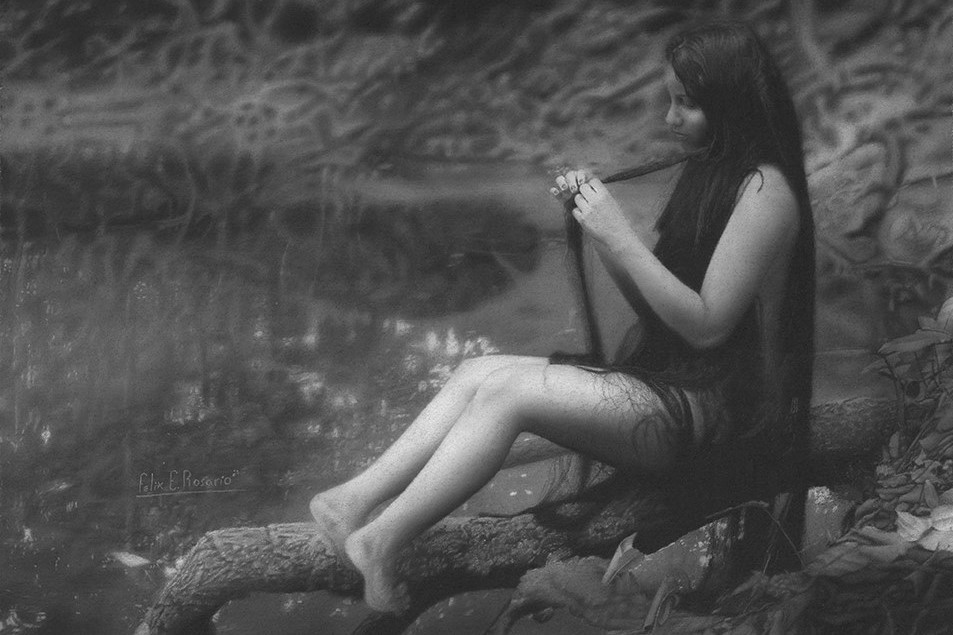
For over a century, stories have been passed down of a creature that lurks within the shadows of the wooded mountainous regions in the Dominican Republic. A feral woman with long dark hair and backwards feet that preys on lonely farmer while he harvest the cacao or the would-be adventurer in search of new routes. Young boys and girls are warned against venturing out into the woods alone with stories of this ravenous creature that feeds on the flesh and souls of men.
His paintings are representations of daily life in contrasting tones of blues, bright reds, orange and yellows; colors of the campos, the village houses, the trees and the surrounding mountains, brought to life by his signature haloed sun. Cándido Bidó (1936–2011) called his art “the themes of daily life... the life of a vendor, a coal worker;” lives that he knew growing up. Bido wrapped his colors in thick bold lines; around the solemn faces of the women and men going about their daily routines. His style is unmistakable and instantly recognizable; a style representational of a land where bright colors and hard work are a way of life.
Photo: Kronos Art BCN @ArtKronos
Cándido Bidó (20 May 1936 – 7 March 2011) was a Dominican painter born in Bonao, capital of the Monseñor Nouel province, in the Dominican Republic. In 1951, he moved to Santo Domingo to work at the Serafín de Asís College, founded on February 2, 1931 by a Community of Franciscan nuns. It is at Serafín de Asís that Bido’s life as an artist takes form. In the afternoons, and with the support of the nuns, Bido begins to study at the School of Fine Arts in Santo Domingo.
“I always have to mention the nuns of the school, because the truth is that being at that mentioned center of studies, is how my life as a painter was born. I had a vocation, I had qualities, but that's when I start to develop them.”
At The School of Fine Arts, Bido had the opportunity to study under the guidance of Gilberto Hernández Ortega, José Gausachs, Clara Ledesma and Jaime Colson; graduating in 1962. Upon graduation, he worked as an assistant professor at the National School of Arts until 1967, when he receives a spot as a faculty professor until 1981. In 1982, he inaugurates the Cándido Bidó Art Center in Santo Domingo, teaching painting, drawing and sculpting. The center operates until 1987, after which, Bido moves back to his hometown of Banao and opens the Cultural Center Plaza, and the Cándido Bidó Art Museum. This is followed by the opening of The School of Arts of the Dominican Air Force in Santo Domingo, in 1996.
Throughout his career, he held more than 20 individual exhibitions, both in the national territory and abroad, including: New York, Puerto Rico, St. Thomas, Colombia, Spain, France, Israel, Brazil, Washington, D.C., London, Germany, Haiti, Italy, Mexico, Ecuador, Venezuela, Costa Rica, Martinique, Korea, Yugoslavia, Japan and Belgium. Among the most important awards obtained by Bidó are: First Prize ESSO Contest of Young Artists (Santo Domingo, 1965); Fourth and Fifth Prize Eduardo León Jimenes Contest (Santiago de los Caballeros, 1967 and 1968, respectively); Third Prize XII National Biennial (Santo Domingo, 1972); First Prize XIII National Biennial (Santo Domingo, 1974); Second Prize XIV National Biennial (Santo Domingo, 1979); First Prize Eduardo León Jimenes Contest (Santiago de los Caballeros, 1981).
For more than 50 years, Bido drew inspiration for his art from his native Bonao and the farm lands of the Cibao and region. His paintings become live scenes of mothers nursing, campesinos in the fields, birds adorning the trees, and lovers in the aldea.
Cándido Bidó passed away on the afternoon of March 7, 2011, from cardio-respiratory failure caused by a severe coronary syndrome. He was 74 years old.
In 1520 — twenty eight years after Christopher Columbus' "discovery" of the new world — Gonzalo Fernández de Oviedo y Valdés (born August 1478 – died 1557), a Spanish historian and writer, was commissioned by the king of Spain to write the official history of the Americas (new world).
In 1535, Oviedo published the first part of "La historia general y natural de las Indias" — "Natural History of the West Indies."
Oviedo's chronicle of the new world included a description of the island of Hispaniola, and it's capital city, Santo Domingo.
Hispanola, from Higuey Point to Cape Tiburon is more than one hundred and firty leagues in length. From the coast of Navidad in the north to Cape Lobos in the South, the island is fifty leagues wide. The city of Santo Domingo is in the southern part of the island at about nineteen degrees north latitude. There are many beautiful rivers and streams on the island and some are quite large, such as the Ozama River, which empties into the ocean at Santo Domingo. Other rivers are the Neyba, which flows close to the town of San Juan de la Maguana, the Artibonito, the Haina, the Nizao, and many smaller ones which I do not care to mention. On the island there is a lake [Lake Enriquillo] about two leagues inland, near the town of Yaguana, which extends fifteen leagues or more to the east. In some places it reaches a width of on to three leagues, but for the most part it is considerably narrower. Most of the lake is salty, but where rivers and springs flow into it the water is fresh. The truth is that this lake is really a “sea eye” which is very near the sea and contains many different kinds of fish, especially large sharks, that enter the lake from the sea by coming under the land or through a place or places through which the sea flows and forms the lake. This is the opinion of most of those who have seen this lake.
FUN FACT -- Lake Enriquillo - formed by the Enriquillo-Plantain Garden fault that extends 79 miles (127 km) from Port-au-Prince Bay in Haiti in the west, to near Neiba Bay in the Dominican Republic in the east — [This fault was responsible for the catastrophic 2010 Haiti earthquake] — is a former marine strait, which was created around 1 million years ago when the water level fell and the strait was filled in by sediments of the Yaque del Sur River... (wiki).
At the time of the discovery, Hispaniola was populated by Indians and was ruled by two kings, Caonabo and Guarionex, and afterwards it passed to the rule of Anacoana. I do not wish to dwell on the conquest or the cause of the reduction in numbers of the Indians, and thus go about describing things I have described in detail elsewhere. This is not the subject I am to treat here, but other details that Your Majesty may not so well or may have forgotten. Concerning this island, however, I wish to say that there are very few Indians there now, and not so many Christians as there should be, since many of those who once were on the island have gone to other islands or to Tierra Firme. Being men fond of adventure those who go to the Indies for the most part are unmarried and therefore do not feel obligated to reside in any one place. Since new lands have been discovered and are being discovered every day, those men believe that they will swell their purses more quickly in new territory. Even though some may have been successful in this, most have been disillusioned, especially those who already have established homes and residence in Hispaniola.
This would be a good point to note that; Bartolomé de las Casas, (1484 - 1566), a 16th-century Spanish historian, social reformer and Dominican friar, referred to Gonzalo Fernández de Oviedo as "one of the greatest tyrants, thieves, and destroyers of the Indies, whose Historia contains almost as many lies as pages"
Las Casas, like Oviedo, also chronicled the history of the new world with "A Short Account of the Destruction of the Indies," in which he focuses on the atrocities committed by Spanish colonialism.
However, it should be noted that Oviedo's purpose was to write something which would be favorable to the crown. Oviedo clearly states (as translated and edited by Stoudmire), that "This is not the subject I am to treat here," in regards to what had become of the natives.
I believe beyond any doubt, and this opinion is held by many that if a prince had no realm except this island, in a short time it would not be inferior to Sicily or England, nor at present is there any reason why either of those islands should be envied. Hispaniola is so rich in natural resources that she could enrich many provinces and kingdoms. In addition to having more rich mines and better gold than have yet been discovered in such quantity anywhere in the world, so much cotton grows wild that if it were cultivated and cared for it would become the best and most productive in the whole world. There are so many excellent drumstick trees that large quantities of the pods are already being brought to Spain and from Spain they are carried and distributed to many parts of the world. This is increasing so rapidly that it is really a marvel. On that island there are many rich sugar plantations. The sugar is of very good quality and ships loaded with it come to Spain every year.
FUN FACT -- The Pueblo Viejo Gold Mine is one of the largest gold mines in the western hemisphere — first mined around the 15th century. The mine is part of the The Archaeological and Historical National Park of Pueblo Viejo, La Vega (also known as the National Park of Concepción de la Vega), in the La Vega Province.
Pueblo Viejo Gold Mine complex
On December, 2012, the Canadian company, Barrick Gold Corp. estimated a probable gold reserves of 15.0 million ounces — with a mining lifetime of 25 years. "The project is designed as an open pit. More than 2.0 million contained ounces of gold have been stockpiled as of November 1, 2012".